Understanding how to read a Comiket circle map is essential if you want to find your favorite circles quickly. The map may look complicated at first, but once you learn how the blocks, numbers, and hall layout work, everything becomes much easier.
This guide explains how to read circle locations such as “東イ‑18a”, how the venue is organized, and how to navigate the floor efficiently—even if it’s your first time at Comiket.
Official Comiket Information (English-friendly):
https://www.comiket.co.jp/info-a/TAFO/
Official Comiket International X Account:
https://x.com/comiket_intl
もくじ
- 1 What a Circle Map Shows
- 2 Check the Correct Day
- 3 Venue Layout Basics(East / West / South Hall Overview)
- 4 Block Types (Hiragana, Katakana, and Alphabet Blocks)
- 5 Island Layout (Shutter-side and Inner-side Positions)
- 6 How to Read a Circle Location (East 1–8, Blocks, and Table Numbers)
- 7 Common Mistakes to Avoid
- 8 Tips for Finding Circles Quickly
- 8.1 1. Search the Circle Name in the Web Catalog First
- 8.2 2. Sort Your List by Hall (東 / 西 / 南)
- 8.3 3. Identify Wall Circles Early
- 8.4 4. Follow the Block Signs Above the Aisles
- 8.5 5. Use the Table Numbers to Fine‑Tune Your Position
- 8.6 6. Avoid Backtracking by Planning a Route
- 8.7 7. Keep the Official Map Open on Your Phone
- 9 Outer Perimeter Blocks
- 10 Conclusion
- 11 Appendix
What a Circle Map Shows
A Comiket circle map is the official floor map that shows where every circle is located inside the venue. Each hall is divided into blocks, and each block contains rows of circles arranged in a grid-like layout. At first glance the map may look overwhelming, but it simply tells you:
- Which hall your circle is in (East / West / South)
- Which block they belong to (hiragana, katakana, or alphabet)
- Which row and table number they occupy
- Whether they are on the inside of an island or near a major walkway
Once you understand how these elements work together, reading a location like “東イ‑18a” becomes much easier.
Check the Correct Day
Comiket takes place over multiple days, and each day features different genres and different circles. This means your target circle may only appear on one specific day, not throughout the entire event.
Before you plan your visit, always check:
- Which day your circle is attending
- Which day your preferred genre is assigned
- Whether the circle appears on Day 1, Day 2, or Day 3
Many first‑time visitors accidentally come on the wrong day and cannot find the circles they wanted. Double‑checking the date is one of the most important steps when preparing for Comiket.
Venue Layout Basics(East / West / South Hall Overview)
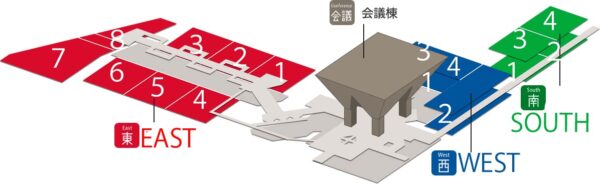
Comiket is held inside Tokyo Big Sight, which is divided into three main areas: East Hall, West Hall, and South Hall. Understanding the basic structure of these halls makes it much easier to locate circles on the map.
- East Hall The largest area, consisting of multiple connected halls (East 1–6). Most doujin circles are located here.
- West Hall Smaller than East, with two floors. Some circles, corporate booths, and cosplay areas may be located here depending on the event.
- South Hall A newer building with four floors. Used for a mix of circles and corporate booths.
Each hall is divided into blocks, and each block contains rows of circles. Once you know which hall your target circle is in, the rest of the map becomes much easier to navigate.
East Hall (東)
The East Hall is the largest area of Comiket, consisting of six connected halls (East 1–6). Most doujin circles are located here, and the layout is dense with many blocks and islands. If your target circle is in the East Hall, expect the widest variety of genres and the highest overall traffic.
West Hals (西)
The West Hall is smaller than the East Hall and has two floors. Depending on the event, it may host doujin circles, corporate booths, or cosplay-related areas. Because of its compact structure, navigation is generally easier than in the East Hall.
South Hall (南)
The South Hall is a newer building with four floors.
It often features a mix of doujin circles and corporate booths, and the layout can vary significantly between events.
Its vertical structure means you may need to move between floors to reach different blocks.
Block Types (Hiragana, Katakana, and Alphabet Blocks)
Comiket uses three different types of block labels to organize circles inside each hall: hiragana, katakana, and alphabet letters. These block labels are part of the circle’s location and appear in combinations such as “東イ‑18a” or “西A‑12b”.
- Hiragana blocks are commonly used in the East Hall.
- Katakana blocks may appear in certain areas depending on the event.
- Alphabet blocks (A–Z) are often used in the West and South Halls.
Each block contains multiple rows (islands), and each row contains several tables. Understanding the block type helps you quickly identify where your target circle is located on the map.
Island Layout (Shutter-side and Inner-side Positions)
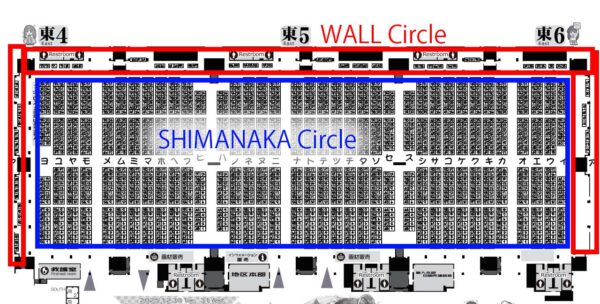
In Comiket’s island layout, circles are arranged in rows called “islands.” Within each island, there are two major positions: Wall-side and inner-side.
- Wall-side This refers to circles placed along the outer perimeter wall of the building, commonly known among attendees as “kabe circles” (wall circles). These spots are typically assigned to highly popular circles. Because their lines often extend outside the building, they are placed near shutters so staff can open them and manage queues outdoors.
- Inner-side These are circles located inside the island, away from the outer walls. Foot traffic is lighter, and queues are usually shorter. Most general circles are placed here.
Knowing whether a circle is on the shutter-side or inner-side helps you plan your route, especially when visiting circles expected to draw long lines.
How to Read a Circle Location (East 1–8, Blocks, and Table Numbers)
Every circle at Comiket has a location code such as “東イ‑18a.”
This code tells you exactly where the circle is located — which hall, block, and table.
Understanding this system helps you find circles quickly on the map.
1. Hall Sections (East 1–8 and Other Halls)
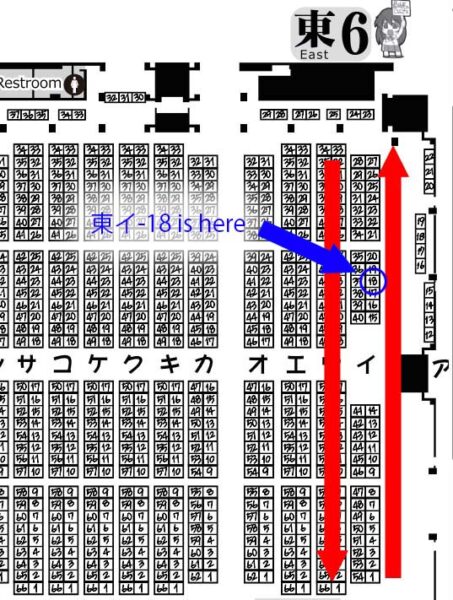
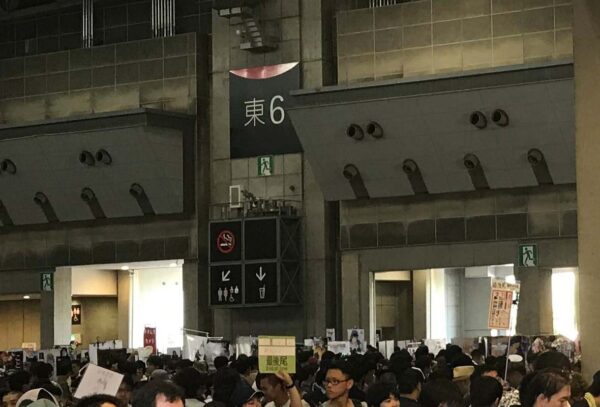
Caption: Example: Location “東イ‑18” inside East Hall 6. The arrows show the walking route from the main aisle.
Comiket circle locations begin with a hall identifier such as East 1–8, West 1–2, or South Halls. These numbers indicate which physical hall the circle is located in.
- East Halls 1–8 The East Hall is divided into eight connected halls. They are grouped as:
- East 1–3
- East 4–6
- East 7–8 Each group often receives different block types depending on the event.
- West Halls 1–2 Smaller, two‑floor structure. Block assignments vary by event.
- South Halls Four‑floor building. Often uses alphabet or lowercase blocks.
Example: Winter Comiket 2025 block assignment
- East 1–3: Closed due to construction
- East 4–6: Katakana ア–ヨ
- East 7–8: Alphabet A–Z
- West 1–2: Hiragana あ–め
- South Halls: Lowercase alphabet a–t
Block assignments change every event, so always check the latest official map.
For visitors who cannot read Japanese, recognizing Hiragana and Katakana is essential for navigating Comiket’s circle map.
The Japan Foundation provides a high‑quality learning tool where you can study both scripts with audio pronunciation, making it easier to match the characters on the official map.
Learn the basics here:
• Hiragana (audio included):https://a1.marugotoweb.jp/en/hiragana.php
• Katakana (audio included):https://a1.marugotoweb.jp/en/katakana.php
These pages are ideal for beginners and help you quickly understand the characters used in Comiket block names.
2. Block Types in Practice (A–Z, a–z, Hiragana, Katakana)
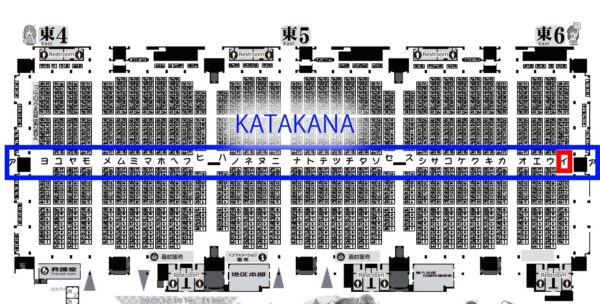
Caption: Katakana blocks (ア–ヨ) used in East Halls 4–6. Each block corresponds to a section labeled with Japanese syllables.
Comiket uses four block systems at the same time:
- Uppercase alphabet (A–Z)
- Lowercase alphabet (a–z)
- Hiragana (あ–ん)
- Katakana (ア–ン)
For foreign attendees, hiragana and katakana can be difficult to distinguish. The safest method is to compare the character printed on the official map with the character in the circle’s location.
How to tell them apart
- Hiragana: round, soft shapes (あ い う え お)
- Katakana: sharp, angular shapes (ア イ ウ エ オ)
Tip: Hiragana = round, Katakana = sharp.
3. Table Numbers and Suffixes (18a, 12b, etc.)
After the block, the next part of the location is the table number, such as 18a or 12b.
- The number indicates the table’s position within the island.
- The letter a / b usually indicates the left or right side of a shared table.
- a = left
- b = right
However, some circles receive a double‑width space, commonly known as “2sp”. In these cases, the circle occupies both a and b, and the location may be written simply as “18ab” or sometimes just “18a” depending on the event’s notation.
Double‑width spaces are typically assigned to circles with large books, displays, or expected high traffic.
Common Mistakes to Avoid
Even if you understand how circle locations work, it’s easy to make small mistakes that lead you to the wrong hall or the wrong block.
Here are the most common pitfalls for first‑time Comiket attendees.
Mistake 1: Confusing Outer Perimeter Blocks
Blocks such as A, a, あ, and ア often appear along the outer perimeter wall.
These areas frequently host popular circles, and queues may extend outside the building.
Many visitors assume these blocks are “near the entrance,” but in reality they refer to wall‑side positions, not the front of the hall.
Mistake 2: Misreading Hiragana and Katakana
Foreign attendees often confuse hiragana (あ) and katakana (ア).
Since both appear as block names, misreading them can send you to the wrong hall.
Always compare the character on the map with the character in the circle’s location.
Mistake 3: Ignoring Hall Numbers
“東イ‑18a” and “西イ‑18a” look similar, but they are in completely different buildings.
Always check the hall prefix (東 / 西 / 南) before looking for the block.
Mistake 4: Assuming Block Assignments Never Change
Block types (A–Z, あ–ん, ア–ン, a–z) change every event.
A block that was in East 4–6 last year may appear in West 1–2 this year.
Always refer to the latest official map.
Tips for Finding Circles Quickly
Finding circles efficiently at Comiket can save you a lot of time—especially during peak hours.
Here are practical tips to help you move smoothly through the venue.
1. Search the Circle Name in the Web Catalog First
Before entering the venue, look up your target circles in the official Web Catalog and note their hall, block, and table numbers.
This prevents you from wandering inside the hall without direction.
2. Sort Your List by Hall (東 / 西 / 南)
Group your circles by hall first, then by block.
Moving between halls takes time, so finish everything in one hall before moving to the next.
3. Identify Wall Circles Early
Wall-side circles (A / a / あ / ア blocks) often have long queues.
Visit them first or last, depending on your priority.
4. Follow the Block Signs Above the Aisles
Each block has a large sign hanging from the ceiling.
Look up as you walk—this is the fastest way to confirm you’re in the right area.
5. Use the Table Numbers to Fine‑Tune Your Position
Once you reach the correct block, check the table numbers (e.g., 12a, 18b).
Numbers usually increase as you move deeper into the island.
6. Avoid Backtracking by Planning a Route
If you have many circles to visit, plan a simple route:
Entrance → Wall circles → Inner islands → Exit
This minimizes unnecessary walking.
7. Keep the Official Map Open on Your Phone
Signal can be unstable inside the halls.
Download the map in advance or take screenshots so you can check locations offline.
Outer Perimeter Blocks
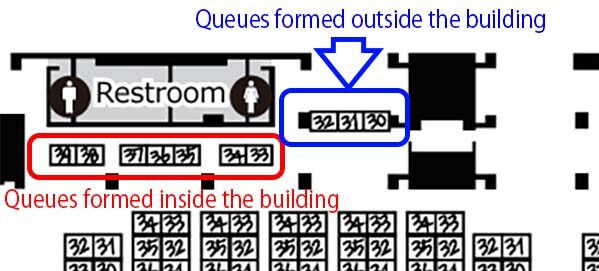
Outer perimeter blocks — often labeled A, a, あ, or ア — are located along the walls of each hall. These areas are commonly known as “wall circles”, and they often host popular or high‑traffic circles.
Two Types of Wall Circles
There are two types of wall circles, and the queueing rules differ:
- Shutter-side circles These circles are placed near large shutters, and their queues may extend outside the building. Staff often open the shutters to manage long lines outdoors.
- Indoor wall circles These circles also sit along the perimeter wall, but their queues remain inside the hall.
When lining up, always check which type of wall circle it is, as the queueing location and staff instructions can be completely different.
Lines May Cross Walkways — But That Does NOT Mean “End of Line”
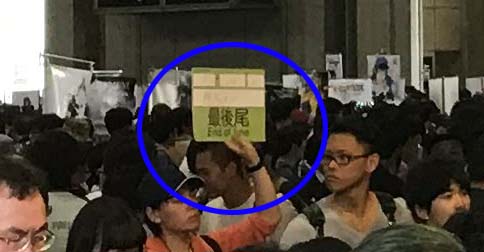
At Comiket, staff may route queues so that they cross walkways or bend around corners to keep traffic flowing. This often happens around wall circles, especially shutter-side circles with long lines.
However, a line crossing a walkway does NOT mean you’ve found the end of the line.
Always look for the “Last in Line” sign (最後尾札) held by staff or attendees. If you join a random segment of the queue, you may accidentally cut in line.
Why They Matter
- Queues can extend outside the hall
- Staff may direct traffic differently around these blocks
- Some circles sell out quickly
- The area can become congested during peak hours
- Check the hall map before entering
- Approach from the main aisle, not from the side
- Follow staff instructions, especially for long queues
- Visit wall circles early if they are a priority
Understanding outer perimeter blocks helps you avoid confusion and move safely through crowded areas.
Conclusion
Comiket’s circle location system may look complicated at first, but once you understand the structure — hall → block → table number — it becomes surprisingly logical. Knowing how to read a location like “東イ‑18a” allows you to move confidently through the venue, avoid common mistakes, and reach your favorite circles without confusion.
Before attending, always check the latest official map, since block assignments and hall usage change every event. With a bit of preparation, navigating Comiket becomes much smoother and far more enjoyable.
Next step: Route from entrance to circle area
Back to :Comiket! The Ultimate Exciting Guide for International Visitors
Appendix
A. Glossary of Terms
- Island (島) A row of circle tables arranged in a block.
- Shutter-side / Wall circle(シャッター前・カベサークル) Circles placed along the outer perimeter wall. Popular circles often appear here.
- Inner-side(島中) Circles located inside the island, away from the outer wall.
- Block(ブロック) A section labeled with A–Z, a–z, あ–ん, or ア–ン.
- 2sp(Two-space table) A double-width space where a circle occupies both “a” and “b”.
B. Example Location Formats
- 東イ‑18a East Hall → Block イ → Table 18 → Left side (a)
- 西あ‑12b West Hall → Block あ → Table 12 → Right side (b)
- 南A‑03ab South Hall → Block A → Table 03 → Two-space (ab)
C. Hiragana & Katakana Reference
Hiragana (round shapes): あ い う え お / か き く け こ / さ し す せ そ …
Katakana (sharp shapes): ア イ ウ エ オ / カ キ ク ケ コ / サ シ ス セ ソ …
Tip: Hiragana = round, Katakana = angular.
D. Quick Checklist Before You Go
- Check the hall prefix(東 / 西 / 南)
- Confirm the block type(A–Z / あ–ん / ア–ン / a–z)
- Verify the table number(18a / 12b / 03ab)
- Look at the latest official map
- Identify whether the circle is wall-side or inner-side